
By Joanna Booher, RDH | 25+ years in dentistry | Airway educator with Awaken2Sleep
If you typed “can sleep apnea kill you” into Google at two in the morning, I want you to take a breath. You are not alone, and you are not overreacting. It is one of the most common questions I hear, and after more than 25 years in dentistry (much of it focused on airway health), I believe you deserve an honest answer, not a scare headline and not a shrug.
So here it is: sleep apnea very rarely kills someone directly, in the night, in one dramatic event. Your body has powerful survival reflexes. When your oxygen drops, your brain jolts you just enough to open the airway and start breathing again, often without you ever remembering it.
But that reassurance comes with a serious asterisk. The real danger of sleep apnea is not what happens in one night. It is what happens over thousands of nights. Untreated sleep apnea slowly wears on your heart, your brain, and your metabolism, and over years it meaningfully raises your risk of the conditions that do shorten lives: heart disease, stroke, atrial fibrillation, high blood pressure, and, according to a growing body of research, even dementia.
In other words, the question is not really “will apnea kill me tonight?” It is “what is untreated apnea doing to me over the next ten or twenty years?” That is the question worth answering, and it is also the one you can actually do something about. Let me walk you through what I have seen and what the science says.
For a plain-language medical overview, the National Heart, Lung, and Blood Institute is a good place to start.
Can Sleep Apnea Kill You? The Honest Short Answer
Obstructive sleep apnea happens when the soft tissues of your throat and tongue relax during sleep and narrow or block your airway. Each time that happens, your oxygen level dips and your brain briefly wakes you to restore breathing. For most people, that arousal reflex works night after night.
That is why a sudden overnight death from apnea alone is rare. What is not rare, and what keeps me passionate about this work, is the slow, cumulative damage. Every pause in breathing does three things:
- It drops your oxygen. Your heart and brain are the most oxygen-hungry organs you have, and they feel every dip.
- It spikes your stress hormones. Each arousal fires your fight-or-flight system, with adrenaline and cortisol surging dozens, sometimes hundreds, of times a night.
- It shatters your sleep architecture. You never settle into the deep, restorative stages of sleep your body needs to repair itself.
Multiply that by 365 nights a year, and you begin to understand why researchers consistently link untreated sleep apnea to higher rates of cardiovascular events and earlier mortality. So, can sleep apnea kill you? Rarely in a single night. But left untreated for years, it can absolutely shorten your life. The good news, which I will keep coming back to, is that this risk is very treatable.
What Untreated Sleep Apnea Does to Your Heart
I often tell my patients that oxygen matters to your heart, but even more to your brain. Let’s start with the heart, because that is where the research is most established.
When your airway closes and oxygen falls, your heart has to work harder to push oxygen-poor blood through your body. At the same time, those repeated adrenaline surges raise your blood pressure, and not just at night. It stays up around the clock. Over years, untreated sleep apnea is associated with:
- High blood pressure that resists medication
- An elevated risk of heart attack and cardiovascular disease
- A significantly increased risk of stroke
- Strain on the heart muscle itself
One connection I want every reader to know about is atrial fibrillation, or AFib, an irregular, often rapid heart rhythm that raises stroke risk. Research shows strong links between untreated sleep apnea and AFib. Here is the part that surprises people: airway problems can begin decades before symptoms like AFib ever show up. The narrowed airway you have in your forties may be quietly setting the stage for the heart rhythm problem that appears in your sixties. Treating the airway earlier is one meaningful way to reduce that long-term risk. It is not a guarantee, but it is a real, evidence-aligned step in your favor.
And I always frame it this way with my patients: treating sleep apnea belongs on the same list as diet, exercise, and stress management. It is not just CPAP or an oral appliance alone. It is one pillar of protecting your heart, alongside everything else your physician recommends.
What It Does to Your Brain: The Research That Keeps Me Up at Night
Here is where my “even more to your brain” comment comes in. During deep sleep, your brain does something remarkable: it flushes out metabolic waste products that build up during the day. Think of it as the brain’s overnight rinse cycle. That housekeeping only happens well when you reach deep sleep and stay there.
Now imagine sleep that is chronically fragmented and oxygen-poor, night after night, for years. The rinse cycle keeps getting interrupted. Researchers are actively studying the links between that kind of disrupted sleep and the buildup of the plaques associated with Alzheimer’s disease and other forms of dementia.
I want to be careful here: this is emerging research, not settled fact, and no one can promise that treating apnea prevents dementia. But I can tell you that sleep quality and Alzheimer’s prevention is one of the biggest topics in our field right now, and the direction of the evidence is sobering. In fact, researchers are now finding that sleep may be almost more important than diet and exercise for long-term health. We spend a third of our lives asleep; it turns out that third is doing heavy lifting for the other two-thirds.
Beyond the long-term questions, poor sleep affects your brain today: foggy thinking, irritability, slower reaction times behind the wheel, and daytime sleepiness that studies link to a higher risk of car accidents. Those risks are immediate, and they disappear quickly when sleep is restored.
Worried about what your nights are doing to your health?
Don’t guess. Get tested. Start with our Free Sleep Assessment, a short online questionnaire, or call AZ Sleep at 623-387-9878 to book a visit with our nurse practitioner, who can prescribe a simple home sleep test you take in your own bed. Medicare and medical insurance accepted.
Is Sleep Apnea Dangerous Even If You “Just Snore”?
This is one of the biggest misconceptions I run into, so let me say it plainly: snoring is the first sign of airway disturbance. It is the sound of air being forced through a narrowed passage. It is your body telling you, out loud, that something in the airway isn’t working the way it should.
Here is what many people don’t realize: your airway doesn’t have to close completely to cause harm. Even partial narrowing reduces the oxygen reaching your body and fragments your sleep. You can spend eight full hours in bed and still wake up exhausted, because your brain never got the unbroken, deep sleep it needed. If you sleep “enough” but still feel like you’re dragging through the afternoon, that is not laziness and it is not just aging. It is a reason to look at your airway.
So is sleep apnea dangerous even in its milder forms? It can be. Mild apnea and chronic snoring with airway narrowing still mean fragmented, oxygen-reduced sleep, and they often progress over time. Catching it early is a gift.
It’s Not Just Overweight, Middle-Aged Men
Close your eyes and picture a “sleep apnea patient.” Most people picture an overweight man in his fifties who snores like a freight train. That stereotype causes real harm, because it convinces everyone else they couldn’t possibly have it.
In my chairs, some of the most affected patients are thin women: women who have been exhausted for years, whose sleep is fragmented night after night, and who have been told their labs look fine so it must be stress. Airway anatomy, jaw structure, and tongue posture matter enormously, and none of those depend on your weight.
Meanwhile, many of the men I see feel perfectly fine, or think they do. They come in only because a wife or partner finally insisted after years of listening to gasping and silence from the other side of the bed. If someone who loves you has told you that you stop breathing at night, please take that seriously. They are often the first and best witness you have.
Understanding Your AHI: Your Sleep Apnea “Score”

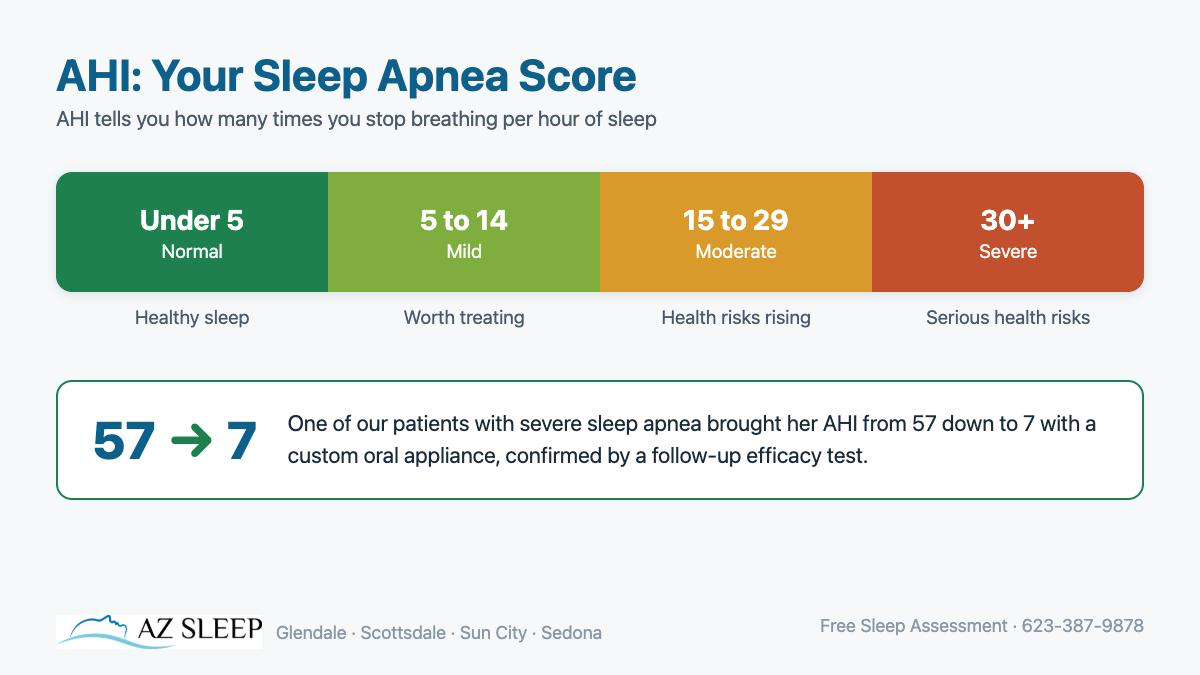
If you get tested, the number you’ll hear about is your AHI, short for apnea-hypopnea index. I describe it to patients as your sleep apnea score: how many times you stop breathing (or nearly stop) per hour of sleep.
- Mild sleep apnea: AHI of 5 to 14 events per hour
- Moderate sleep apnea: AHI of 15 to 29 events per hour
- Severe sleep apnea: AHI of 30 or more events per hour
Sit with that for a moment. Severe apnea means your breathing is interrupted at least thirty times every hour, or once every two minutes, all night long. Even “mild” apnea means your sleep is being broken five to fourteen times an hour. No one thrives on that.
The only way to know your number is to test. Please don’t self-diagnose, and please don’t self-dismiss, either. A home sleep test is simple, comfortable, and done in your own bed, and it gives you real data instead of worry. Because a sleep study has to be prescribed by a medical provider (dentists can’t order one), the first step at AZ Sleep is a visit with our nurse practitioner, billed under your medical insurance. The test itself uses a disposable, FDA-cleared device that you keep, so there is nothing to mail back. Our nurse practitioner then reviews your results and makes the diagnosis.
A Story of Hope: From an AHI of 57 to 7
Because this article asks a frightening question, I want to leave you with a true story (details kept anonymous) that shows the other side.
A patient of mine, someone who works in the dental field and who you’d think would have caught this, tested with an AHI of 57. That is highly severe: breathing interrupted nearly once a minute, every hour, every night. The long-term cardiovascular risk attached to a number like that is exactly what the first half of this article describes.
We treated her with a custom-fitted oral appliance. It is a small device, made from impressions of her own teeth, that gently holds the lower jaw forward to keep the airway open during sleep. On follow-up testing, her AHI had dropped from 57 to 7.
From severe to borderline-mild. More energy within weeks. Deeper, quieter sleep. And most importantly, a dramatically lower burden on her heart and brain going forward. Her risk didn’t vanish (no treatment can promise that), but it fell substantially, and she got her days back in the process.
That is why I do this work. The scary numbers are real, but so is the fix.
Treatment Isn’t One-Size-Fits-All (and It Isn’t Only CPAP)
Many people avoid getting tested because they dread the idea of a CPAP machine. I understand, and I want to reframe it.
First, some people genuinely love their CPAP. It is a well-proven therapy, and for certain patients it is the right call. There are side effects to everything, and the best treatment is the one you will actually use every night.
Second, CPAP is not the only option. Oral appliance therapy, the kind of treatment we provide at AZ Sleep, is an effective option for many people with sleep apnea, particularly those with mild to moderate apnea and those who cannot tolerate CPAP. It is small, silent, travels easily, and requires no electricity, no hose, and no mask. As the story above shows, in the right patient it can deliver life-changing results even in severe cases.
The right path starts with real data from a sleep test, a diagnosis from our nurse practitioner, and a conversation about your anatomy, your health history, and your life. Once you have a diagnosis, we offer a complimentary consultation with our dental sleep team. With your sleep study and your provider’s clinical notes in hand, we talk through whether oral appliance therapy is the right treatment for you. You can read more about what to expect on our new patient examination page.
Curious whether an oral appliance could work for you?
Start with our Free Sleep Assessment or call to see our nurse practitioner. After a diagnosis, our dental sleep team offers a complimentary consultation about oral appliance therapy, with no pressure and no jargon. We accept Medicare and medical insurance, and we have four Arizona locations.
Frequently Asked Questions
Can you die in your sleep from sleep apnea?
It is rare for sleep apnea alone to cause death during the night, because the brain’s arousal reflex restarts breathing when oxygen drops. The more significant danger is cumulative. Untreated apnea raises long-term risk of heart attack, stroke, and dangerous heart rhythms like atrial fibrillation, and some of those events do occur during sleep, when apnea’s strain on the heart is greatest. Testing and treatment are the way to lower that risk.
Can you die from sleep apnea if it’s only mild?
Mild apnea (an AHI of 5 to 14) is far less risky than severe apnea, but it still means fragmented, oxygen-reduced sleep, and it often worsens over time. Think of mild apnea as an early warning worth acting on, not a diagnosis to ignore.
What are the biggest untreated sleep apnea risks?
The best-documented risks are cardiovascular: high blood pressure, heart disease, stroke, and atrial fibrillation. Researchers are also actively studying links between chronically fragmented, oxygen-poor sleep and dementia risk. More immediately, untreated apnea causes daytime exhaustion, brain fog, and drowsy driving.
How do I find out if I have sleep apnea?
Don’t self-diagnose. Get tested. Start with our Free Sleep Assessment online or call 623-387-9878 to see our nurse practitioner, who can prescribe a home sleep test that measures your breathing, oxygen levels, and AHI in your own bed. Our nurse practitioner reviews the results and makes the diagnosis.
You Asked an Important Question. Now Take the Next Step.
If you came here afraid, I hope you’re leaving informed instead. Sleep apnea is unlikely to take your life tonight, but untreated, it quietly stacks the odds against your heart and brain for years to come. Those are odds you can change, starting this week, with a short online assessment or one phone call to see our nurse practitioner.
Twenty-five years in dentistry have taught me that the patients who act early are the ones who get their energy, their mornings, and their peace of mind back. If you’d like to keep reading first, our patient library has more plain-language answers about sleep apnea, snoring, and treatment.
AZ Sleep: Sleep Apnea Testing and Treatment at Four Arizona Locations
Take the Free Sleep Assessment or call 623-387-9878 to see our nurse practitioner. Medicare and medical insurance accepted.
- Glendale: 7200 W Bell Road, Suite C3
- Scottsdale: 10245 E Via Linda, Suite 226
- Sun City: 13203 N 103rd Ave, Suite G1
- Sedona: 1146 W State Rte 89A, Suite C1
Ready to find out what’s happening with your sleep?
It starts with our Free Sleep Assessment: a few quick screening questions, at no cost and with no referral needed. Medicare and medical insurance accepted.
Free Sleep Assessment
or call 623-387-9878 · Glendale · Scottsdale · Sun City · Sedona

Author: Joanna Booher, RDH
25+ years in dentistry · Airway educator with Awaken2Sleep · Licensed Dental Hygienist, AZ #H05418 (verify) · LinkedIn