
By Joanna Booher, RDH | 25+ years in dentistry | Airway educator with Awaken2Sleep
If you’ve ever typed “do I have sleep apnea” into your phone at 3 a.m. because you woke up exhausted again, this article is for you. I’ve spent more than 25 years in dentistry, and here’s something that surprises almost everyone I meet: I can often spot the signs of sleep apnea in someone’s mouth before they ever say a word about their sleep. The clues are sitting right there in the teeth, the tongue, and the tonsils, and most people have no idea.
So I put together the checklist I run through in my own head chairside. Ten signs. None of them, on their own, is a diagnosis; only a sleep test can confirm sleep apnea. But if you find yourself nodding along to three, four, five of these, that’s your body telling you something. Think of it as an honest sleep apnea quiz from someone who looks in mouths for a living, right here in Arizona: Glendale, Scottsdale, Sun City, Sedona, and everywhere in between.
First, Two Myths I Have to Bust
Before the checklist, let me clear away the two things I hear almost every week.
Myth one: “Snoring’s not bad. Everybody snores.” False. Snoring is the first sign of an airway disturbance: air fighting its way through a narrowed passage. And the airway doesn’t have to close completely to cause trouble. Even a partial narrowing reduces the oxygen getting to your body and fragments your sleep, night after night. Snoring isn’t a quirk. It’s a signal.
Myth two: “I don’t have sleep apnea. I’m not a 50-year-old overweight man.” I hear this one constantly, usually from women. In my experience, some of the most affected patients are thin women. Women tend to get the symptoms (the fragmented sleep, the daytime fatigue, the feeling of running on empty), while many men only come in because a bed partner finally insists. One of my favorite lines from a patient: “I don’t snore, I purr.” She purred her way right into a sleep test, and it changed her life.
Sleep apnea doesn’t check your age, your weight, or your gender before it moves in. Now, the checklist.
Do I Have Sleep Apnea? The 10-Point Checklist
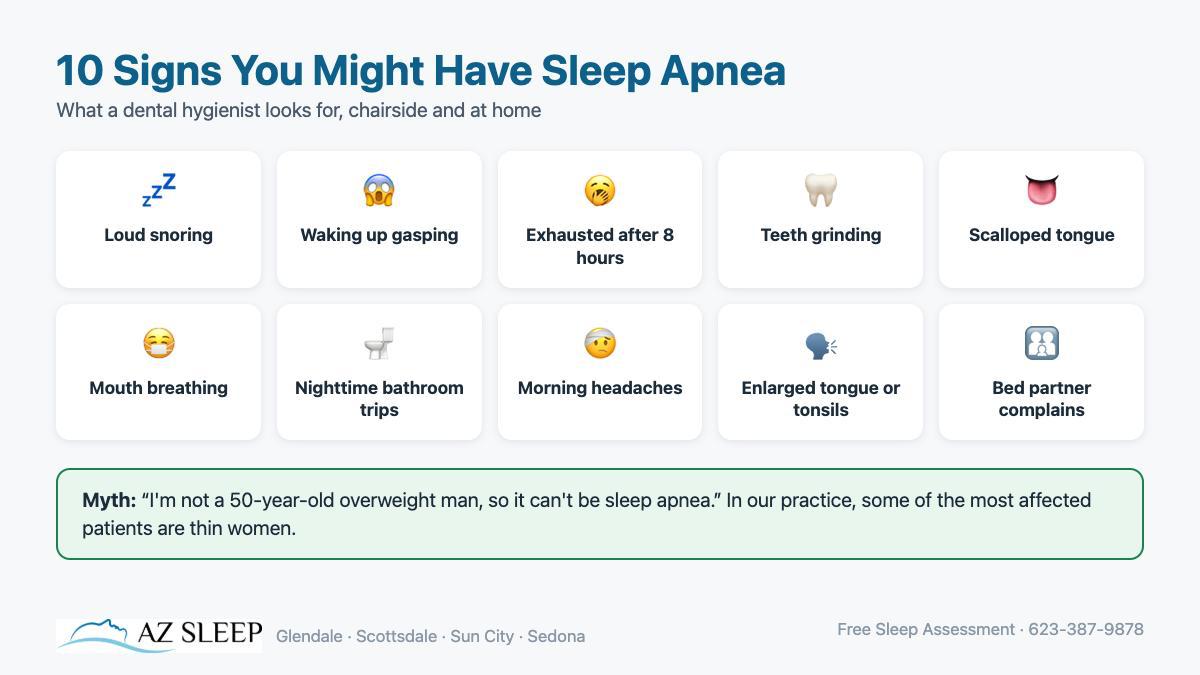
For each point, I’ll tell you what it is, why it matters, and what I actually see chairside. Keep a mental tally as you go.
1. You Snore, Even “Just a Little”
What it is: Any regular noise during sleep, from a soft purr to a freight train.
Why it matters: Snoring means your airway is narrowing while you sleep. Narrowing means less oxygen and lighter, broken-up sleep, even if you never fully stop breathing. It is the single most common early sign of an airway disturbance, and it’s the one most people wave off.
What I see chairside: Patients almost never volunteer this. I ask, “Do you snore?” and they say no. Then the spouse laughs. If anyone has ever told you that you snore, count this as a yes.
2. You Grind or Clench Your Teeth
What it is: Grinding (bruxism) or clenching at night, often without knowing it.
Why it matters: This is the sign that surprises people most. Grinding is frequently the body’s response to an airway problem. When the airway narrows, the jaw thrusts forward and the teeth grind as the body fights to reopen the passage. It’s not just stress. Sometimes it’s survival.
What I see chairside: Flattened, worn-down teeth. Chipped edges. Cracked fillings. I see it in patients from Glendale to Sun City, and when I ask about their sleep, the story almost always fills in. If your dentist has ever recommended a night guard, ask the next question: why am I grinding?
3. You Have a Scalloped Tongue
What it is: Wavy, ruffled indentations along the sides of your tongue, like the edge of a pie crust.
Why it matters: Those scallops are tooth prints. They mean your tongue is pressing hard against your teeth because it doesn’t have enough room, and a tongue without enough room tends to fall back into the airway at night.
What I see chairside: This is one of my favorite teaching moments. I’ll hand a patient a mirror and show them the scalloping, and they’re stunned. They never knew their tongue was telling a story. Go look in your bathroom mirror. Wavy edges? Mark it down.
4. Your Tongue Is Large for Your Mouth, or Tied Down
What it is: An enlarged tongue, or a tongue tie (a tight band of tissue under the tongue that restricts its movement).
Why it matters: The tongue is the biggest piece of real estate in your airway. If it’s oversized for the space, or tethered low and back by a tongue tie, it’s far more likely to collapse into the throat during sleep. Tongue ties also push people toward mouth breathing, which makes everything worse.
What I see chairside: When I can barely see the back of someone’s throat because the tongue fills the whole view, that’s a red flag. Tongue ties are something many adults have carried since birth without anyone ever pointing them out. I point them out.
5. Your Tonsils Are Enlarged
What it is: Tonsils big enough to crowd the back of the throat.
Why it matters: Enlarged tonsils physically shrink the airway. Every millimeter of crowding back there makes nighttime breathing harder.
What I see chairside: I check every patient. Plenty of adults have never once been told their tonsils are large, because nobody looked after childhood. It takes me five seconds, and it’s one more piece of the puzzle.
6. You Breathe Through Your Mouth
What it is: Mouth breathing during the day, at night, or both. Waking up with a dry mouth is the classic giveaway.
Why it matters: Noses are for breathing; mouths are for eating and talking. Mouth breathing bypasses the nose’s filtering and warming, destabilizes the airway, dries out the mouth (hello, cavities and gum problems), and is strongly linked to disturbed sleep.
What I see chairside: Dry, red gums along the front teeth, and more decay than the patient’s brushing habits can explain. Chapped lips in a Scottsdale summer is one thing, but that pattern of dryness inside the mouth tells me what’s happening at 2 a.m.
7. You Wake Up Gasping or Choking
What it is: Jolting awake with a snort, a gasp, or the feeling you couldn’t breathe.
Why it matters: This is your brain hitting the emergency brake. The airway closed, oxygen dropped, and your body yanked you out of sleep to reopen it. Of all ten signs of sleep apnea in adults, this is the one I take most seriously. Please don’t sit on this one.
What I see chairside: Patients often mention it almost as an afterthought: “Oh, sometimes I wake up kind of choking, is that weird?” Yes, friend. That’s not weird, that’s urgent. That’s a sleep testing conversation, today.
8. You Sleep Eight Hours and Still Feel Exhausted
What it is: Daytime fatigue that doesn’t match your time in bed. Dozing off in meetings, in church, or (scarier) at red lights.
Why it matters: Here’s how I explain it to patients: somebody can sleep eight hours, have an airway disturbance, and still feel exhausted. Hours in bed are not the same as restorative sleep. If your airway is narrowing all night, your brain never gets the deep, repairing sleep it needs, no matter what the clock says.
What I see chairside: This is the symptom my female patients carry most. They’ve been told they’re stressed, they’re anemic, they’re “just busy.” Sometimes those things are true. But when exhaustion pairs with a scalloped tongue and worn teeth, I know where to look next. If you’ve been asking yourself “am I at risk for sleep apnea?” because no amount of sleep helps, this point alone is worth taking our Free Sleep Assessment.
9. You’re Up Two or Three Times a Night to Use the Bathroom
What it is: Frequent nighttime bathroom trips. The medical word is nocturia.
Why it matters: Most people blame their bladder or their age. But oxygen drops during sleep trigger a hormone response that increases urine production overnight. Translation: sometimes it’s not your bladder waking you up. It’s your airway.
What I see chairside: I hear this constantly from my Sun City patients, who assume it’s simply part of getting older. When we test them and treat the airway, a lot of them tell me the bathroom trips quietly faded. That’s not a coincidence.
10. You Wake Up With Headaches
What it is: A dull, pressure-type headache first thing in the morning that usually eases within an hour or two.
Why it matters: All night long, drops in oxygen and rises in carbon dioxide dilate blood vessels in the head. You wake up with the bill. Morning headaches plus grinding plus snoring is a pattern I’d bet on every time.
What I see chairside: Patients who open with “I’ve had headaches forever.” When the history includes snoring and the exam shows wear on the teeth, the headache often isn’t the problem. It’s the symptom.
Checking off more boxes than you expected? Don’t guess. Get tested. Start with our Free Sleep Assessment, a short online questionnaire, or call 623-387-9878 to schedule a visit with our nurse practitioner. Testing is a simple home sleep test in your own bed. Four Arizona locations: Glendale, Scottsdale, Sun City, and Sedona. Medicare and medical insurance accepted.
How to Score Yourself
This isn’t a formal sleep apnea quiz with an official cutoff, so I’ll give you my honest, hygienist’s version:
- 0 to 1 signs: Low concern. Keep an ear out (literally: ask your bed partner).
- 2 to 3 signs: Worth a conversation. Mention it at your next dental visit, or take our Free Sleep Assessment.
- 4 or more signs: Please get tested. Not someday, soon. Call to schedule with our nurse practitioner. The checklist indicates risk; a sleep test gives you the answer.
- Any gasping or choking awake: That one jumps the line. Call regardless of your total.
And one more time, because it matters: these symptoms don’t diagnose anything. I’ve seen a quiet little “purr” come back with a serious result. Testing is the only way to know.
What Happens Next: The Home Sleep Test and Your AHI
The good news: finding out is easier than ever. Only a medical provider can prescribe a sleep study (dentists can’t), so you’ll first see our nurse practitioner, billed under medical insurance. No night wired up in a lab: you get a small, disposable, FDA-cleared home sleep test device, you sleep in your own bed, and it records what your breathing actually does overnight. It’s yours to keep, nothing to return.
The test gives you a number called your AHI. Patients’ eyes glaze over when they hear “apnea-hypopnea index,” so here’s how I say it: your AHI is your sleep apnea score, how many times you stop breathing an hour. Our nurse practitioner reviews your results and makes the diagnosis. Once you know that number, you can talk real options instead of guesses. If you’re diagnosed, you’re invited to a complimentary consultation with our dental sleep team about oral appliance therapy, and for many of our patients, treatment is a comfortable custom oral appliance rather than a CPAP machine.
Curious what a first visit looks like? You can read about our new patient examination, and if you’re the type who likes to research first (I respect that), our patient library is full of plain-English answers.
Why a Dental Office Is Looking at Your Sleep
People sometimes raise an eyebrow: why is a dental practice talking to me about sleep apnea? Simple. Your dentist and hygienist look inside your mouth more often, and more closely, than any other health professional in your life. We see the worn teeth, the scalloped tongue, the big tonsils, the dry tissue, years before most people ever mention sleep to their physician.
That’s why I became an airway educator with Awaken2Sleep after decades of cleanings and checkups. I got tired of seeing the signs and having nowhere to send people. At AZ Sleep, that’s the whole mission: spot it, test it, treat it, right here in Arizona.
Frequently Asked Questions
How do I know if I have sleep apnea without a sleep study?
Honestly, you can’t know for certain, and I’d never pretend otherwise. The checklist above tells you whether you’re at risk, and the more signs you have, the stronger the case for testing. But only a sleep test can confirm sleep apnea and tell you how significant it is. The upside: a home sleep test is simple, comfortable, and done in your own bed.
Can thin people and women have sleep apnea?
Absolutely. This is the myth I bust most often. In my chair, some of the most affected patients are thin women. Airway anatomy, tongue size, tongue ties, and jaw structure matter far more than the stereotype of the heavyset older man. If you’re a woman who sleeps eight hours and still feels exhausted, please don’t rule yourself out.
Is snoring always sleep apnea?
No, but it’s never meaningless. Snoring is the first sign of an airway disturbance. Some snorers have full-blown sleep apnea; others have partial narrowing that still reduces oxygen and fragments sleep. Either way, “everybody snores” is not a reason to ignore it. It’s a reason to check.
How do I get started with sleep apnea testing at AZ Sleep?
Start with our Free Sleep Assessment, a short online questionnaire, or call us. The next step is a visit with our nurse practitioner, a medical visit billed under your medical insurance (we accept Medicare and medical insurance). If it makes sense, our NP prescribes a home sleep test, then reviews your results and makes the diagnosis. Or reach out through our contact page.
Ready for a real answer instead of a 3 a.m. search? Take our Free Sleep Assessment or call to schedule a visit with our nurse practitioner at any of our four Arizona locations:
- Glendale: 7200 W Bell Road, Suite C3
- Scottsdale: 10245 E Via Linda, Suite 226
- Sun City: 13203 N 103rd Ave, Suite G1
- Sedona: 1146 W State Rte 89A, Suite C1
Call 623-387-9878. Medicare and medical insurance accepted. You deserve to wake up rested, so let’s find out what’s really happening while you sleep.
This article is for educational purposes and does not diagnose any condition. A checklist can indicate risk; only a sleep test, reviewed by a qualified provider, can confirm sleep apnea.
Ready to find out what’s happening with your sleep?
It starts with our Free Sleep Assessment: a few quick screening questions, at no cost and with no referral needed. Medicare and medical insurance accepted.
Free Sleep Assessment
or call 623-387-9878 · Glendale · Scottsdale · Sun City · Sedona

Author: Joanna Booher, RDH
25+ years in dentistry · Airway educator with Awaken2Sleep · Licensed Dental Hygienist, AZ #H05418 (verify) · LinkedIn