
By Joanna Booher, RDH | 25+ years in dentistry | Airway educator with Awaken2Sleep
If you’ve been told you snore, or you wake up every morning feeling like you barely slept, someone has probably suggested a sleep study. And you’ve probably pictured a night in a lab, covered in wires, trying to sleep in a strange bed. There’s a different option. A home sleep test in Arizona lets you find out what’s happening with your breathing at night from your own bedroom, in your own bed, on your own schedule. After 25+ years in dentistry and years of teaching airway health, I can tell you it has changed everything about how easily our patients get answers.
Below, I’ll walk you through how an at home sleep apnea test works, what the night looks like, what the device measures, who qualifies, and who should go to a lab instead. It’s the same plain-spoken explanation I give patients at our four Arizona locations in Glendale, Scottsdale, Sun City, and Sedona every week.
What Is a Home Sleep Test?
A home sleep test (you’ll also hear it called a home sleep study or a home sleep apnea test) is a small, prescribed medical device you wear for one night while you sleep in your own bed. It records what your body is doing while you breathe, or stop breathing, overnight. Our nurse practitioner then reviews the results with you, and those results tell us whether you have sleep apnea and, if so, how severe it is.
This is a real diagnostic test, prescribed by a medical provider, not a smartwatch app or a snoring recorder. The only difference is where you sleep.
The American Academy of Sleep Medicine’s patient guide to obstructive sleep apnea is another good resource if you want the background.
When patients sit down with me, they almost always ask the same five questions: How does it work? Is it comfortable? Will insurance pay for it? How effective is it? And how long until I find out my results? I’m going to answer every one of those below.
Home Sleep Test vs. Overnight Lab Study: What’s the Difference?
An overnight lab study (the formal name is polysomnography) is still the gold standard for complicated cases. You sleep at a sleep center with sensors on your scalp, face, chest, and legs, and a technician monitors you all night. It captures more data, including brain waves and sleep stages.
But here’s the honest truth I share with patients: a lab study only works if you can actually sleep during it. And for a lot of people, sleeping in an unfamiliar bed, wired up, knowing they’re being watched, is nearly impossible. A sleep test without a lab removes all of that.
With a home sleep test, you get:
- Your own bed. Your pillow, your mattress, your room temperature. The test captures a far more natural night of sleep.
- Your own routine. Go to bed when you normally do. Read, watch TV, let the dog in the room.
- No waiting list for a lab bed. Across Arizona, lab studies can take weeks to schedule. A home test can usually happen within days.
- Lower cost and better coverage. Home tests are typically far more accessible than lab studies, and we accept Medicare and medical insurance for testing.
For most people with suspected obstructive sleep apnea, which is by far the most common type, a home test gives us everything we need to make a diagnosis.
How Does a Home Sleep Test Work? A Step-by-Step Look at the Process
This is the part patients are most curious about, so let me walk you through it the way I would in the office.
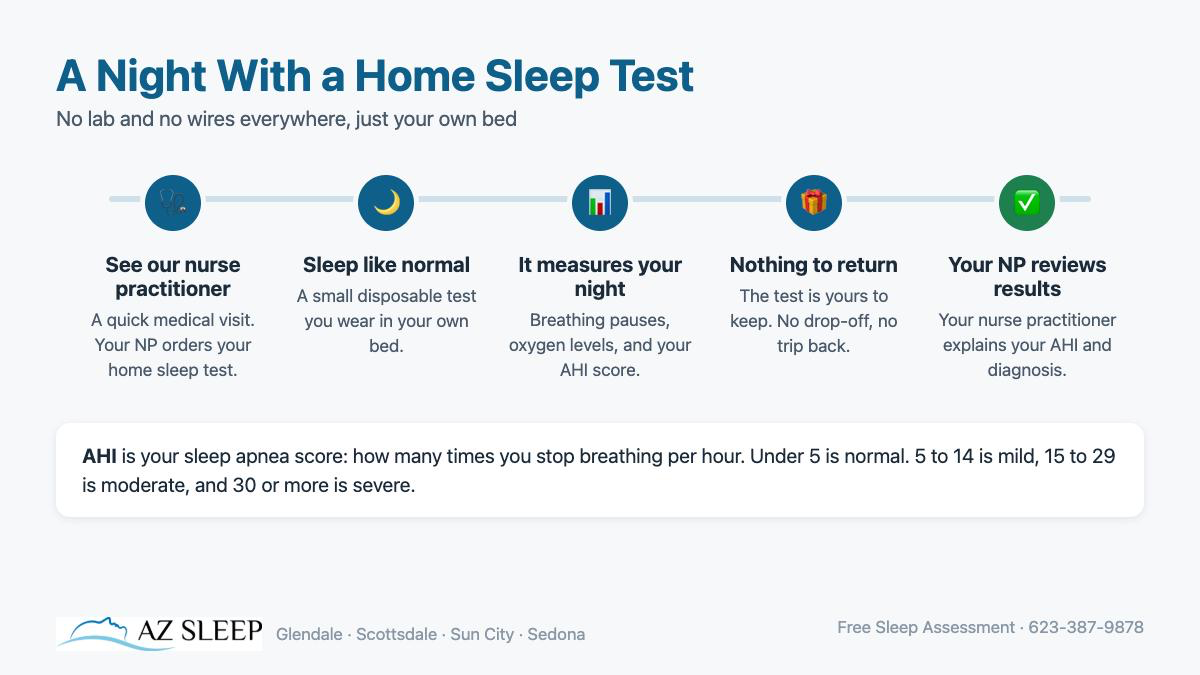
- Start with our Free Sleep Assessment. It’s a short online screening questionnaire you can take at our Free Sleep Assessment page, or you can call us at 623-387-9878.
- See our nurse practitioner. Your next step is a visit with our nurse practitioner (NP). This is a medical visit, billed under your medical insurance, and we accept Medicare and medical insurance. It matters because only a medical provider can prescribe a sleep study. Dentists cannot. Your NP reviews your symptoms and health history and decides whether a home test is right for you.
- Your NP prescribes the home sleep test. We use a disposable, FDA-cleared home sleep test device. It’s yours to keep for your whole time with our office, so there’s no pick-up, no drop-off, and nothing to return. Most patients are surprised by how simple it is.
- You go to bed like normal. That night, you put the device on right before you turn out the light. Then you just sleep. There’s no technician, no camera, no lab gown.
- The device records your night. While you sleep, it’s quietly collecting data on your breathing, your oxygen levels, your heart rate, and more. I’ll cover exactly what it measures in a moment.
- Our NP reviews your results with you. Once your study is in, our nurse practitioner sits down with you, goes over exactly what it found and what it means, and makes the diagnosis.
Is it comfortable? Honestly, yes, far more than people expect. Our home sleep test is a small device worn on your finger. Patients tell me they noticed it for the first twenty minutes and then forgot it was there. Compared to a lab study’s dozens of wires, it’s not a close contest.
Is This the Same as My Smart Ring or Smartwatch?
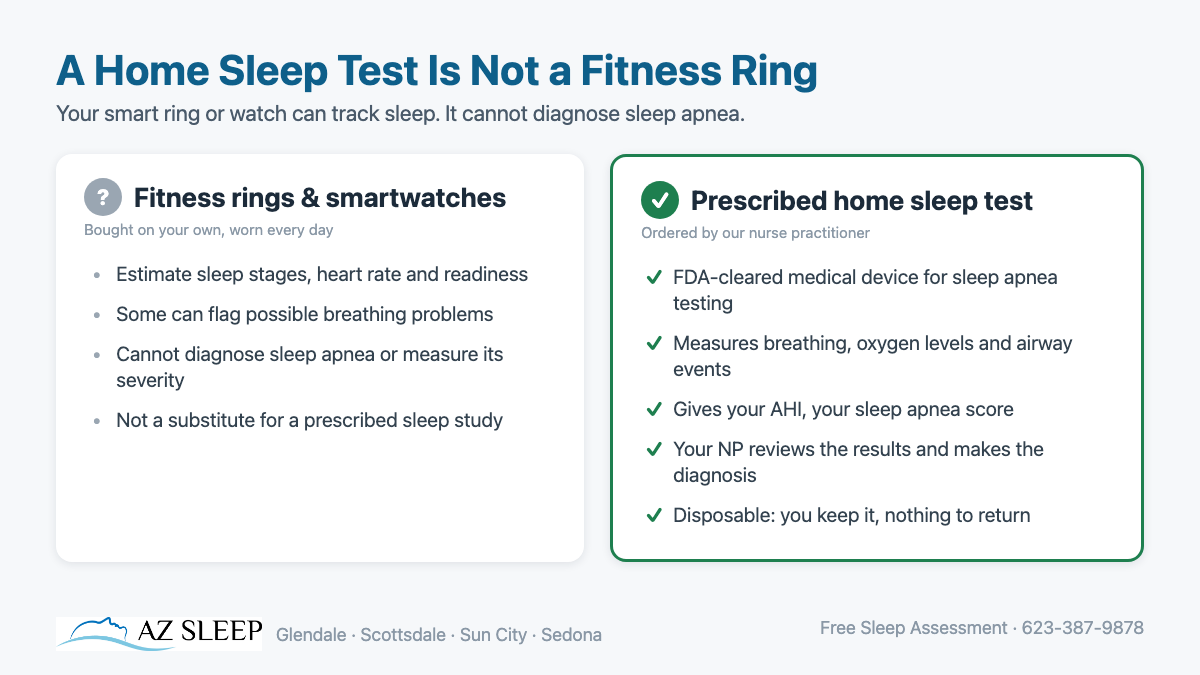
No, and it’s one of the most common questions I hear. Fitness rings and smartwatches can estimate your sleep, and some can even flag possible breathing problems. But they aren’t designed to diagnose sleep apnea or tell us how severe it is, and they can’t take the place of a sleep study.
A home sleep test is more involved than any wearable. It’s a prescribed medical device, FDA-cleared for sleep apnea testing, that records your breathing, your oxygen levels, and every time your airway narrows or closes through the night. Then our nurse practitioner reviews those results and makes the diagnosis. So if your watch or ring has been hinting that something is off, take that as a good reason to start our Free Sleep Assessment. Just don’t let it stand in for the real test.
Wondering if a home sleep test is right for you?
Start with our Free Sleep Assessment, then schedule a visit with our nurse practitioner at any of our four Arizona locations: Glendale, Scottsdale, Sun City, or Sedona. Medicare and medical insurance accepted.
Call 623-387-9878 or take your Free Sleep Assessment.
What Does the Device Actually Measure?
A home sleep study device is small, but it’s gathering a serious amount of information. Depending on the device, a single night’s recording typically includes:
- Breathing effort and airflow: whether air is actually moving in and out, and whether your body is working hard to make it happen.
- Pauses in breathing: how many times your breathing stops or becomes dangerously shallow, and for how long.
- Blood oxygen levels: every time your airway closes, your oxygen drops. The device tracks those dips all night long.
- Heart rate: your heart responds to every one of those oxygen drops, and the pattern tells us a lot.
- Snoring: intensity and frequency. Snoring is the first sign of airway disturbance, so it’s worth measuring, not just teasing someone about.
- Body position: some people only have apnea events when they sleep on their back, and that detail shapes treatment.
All of this gets combined into one number that matters most: your AHI.
Understanding Your AHI: Your Sleep Apnea Score
AHI stands for apnea-hypopnea index, but I tell patients to think of it as your sleep apnea score. It tells you how many times you stop breathing an hour. Here’s how the severity bands break down:
- Mild sleep apnea: AHI of 5 to 14. You stop breathing 5 to 14 times every hour.
- Moderate sleep apnea: AHI of 15 to 29.
- Severe sleep apnea: AHI of 30 or more. That’s at least one breathing interruption every two minutes, all night, every night.
When patients see their number for the first time, something clicks. The exhaustion, the brain fog, the irritability: suddenly it has an explanation. One of my patients tested at an AHI of 57. Fifty-seven times an hour her body was fighting for air, and she had no idea. More on her story in a minute, because it has a very happy ending.
How Are the Results Read, and How Long Does It Take?
After your night with the device, our nurse practitioner reviews your study. Your NP looks at your AHI, your oxygen patterns, how long the events lasted, and whether position played a role.
Patients always ask how long until they find out. In most cases, results come back within days, not weeks. Once they’re in, you meet with our NP to review them. Your NP explains your score in plain English and makes the diagnosis. No Googling medical abbreviations at midnight.
Who Qualifies for a Home Sleep Test in Arizona?
Here’s who should seriously consider testing, and I want you to notice how ordinary this list is:
- Snorers. Snoring is the first sign of airway disturbance. It is not just a noisy habit. It’s the sound of air squeezing through a narrowing airway.
- People who are exhausted despite getting 8 hours. If you’re in bed a full night and still dragging through your afternoons, the problem may not be how long you sleep but how well you breathe while you do.
- People who wake up gasping or choking. That’s your body jolting itself awake to reopen your airway.
- Frequent night wakers. Waking several times a night, including to use the bathroom, is a common and overlooked sign.
And here’s something I see constantly in practice that most people don’t expect: sleep apnea is not just a condition for heavy-set, middle-aged men. In our offices, thin women with fragmented sleep are among the most affected patients we see. They’ve often been told for years that it’s stress, or hormones, or “just how you sleep.” Meanwhile, many of the men we test only come in because a bed partner finally pushed them through our door. If your spouse has been nudging you about your snoring, this is your sign.
Not sure your symptoms add up? Take a few minutes with our “Do I Have Sleep Apnea?” guide. It walks through the warning signs in detail.
Who Should Do a Lab Study Instead?
I’ll be straight with you: a home sleep test isn’t right for everyone, and we’ll tell you if it isn’t right for you. A lab study is usually the better call when:
- There’s suspicion of central sleep apnea, where the brain (not a blocked airway) is the problem.
- You have significant heart, lung, or neuromuscular conditions that need closer monitoring.
- Other sleep disorders are suspected, like narcolepsy or severe periodic limb movement, which need brain-wave data a home device doesn’t capture.
- A home test came back negative but your symptoms strongly suggest apnea. Sometimes we need the lab’s deeper look.
This is exactly why testing decisions are made with a medical provider, not off a website. Your visit with our nurse practitioner sorts out which path fits your situation.
Ready to find out your sleep apnea score?
Your first step is our Free Sleep Assessment. From there, we’ll schedule you with our nurse practitioner, who can prescribe a home sleep test if it’s right for you. Learn about our new patient examination. Medicare and medical insurance accepted.
Call 623-387-9878 or take your Free Sleep Assessment. Glendale, Scottsdale, Sun City, and Sedona.
What Happens After Your Results Come Back?
The test is only the beginning. Here’s the pathway we follow with every patient:
- Assessment, NP visit, and home test: the screening, your medical visit, and one night in your own bed.
- Results and diagnosis: our NP reviews your results with you and makes the diagnosis.
- Complimentary consultation, if it fits: if you’re diagnosed with sleep apnea and oral appliance therapy may be right for you, you’ll have a complimentary consultation with our dental sleep team once we receive your sleep study and your provider’s clinical notes.
- Treatment: for many patients, that’s a custom oral appliance, a small, comfortable device worn at night that holds the airway open. No mask, no hose, no machine humming on the nightstand.
- Follow-up efficacy test: this step is one I’m genuinely proud of. After treatment, we test again to confirm the appliance is actually working. We don’t guess; we verify.
Remember my patient with the AHI of 57? After she was fitted with her custom oral appliance, her follow-up test came back at an AHI of 7. From 57 events an hour down to 7. That follow-up test is how we knew for certain, not just hoped, that her treatment was working.
If your results show you don’t have sleep apnea, that’s valuable too. We can start looking at other reasons your sleep isn’t restoring you, and point you to the right next step.
Why Arizona Patients Choose Home Testing
Whether you’re in the Phoenix metro or anywhere else in the state, access matters. Lab beds are limited, schedules are tight, and summer nights away from your own air conditioning are nobody’s idea of restful. A home sleep test in Arizona removes nearly every barrier between “I think something’s wrong with my sleep” and an actual answer. It’s faster to schedule, covered by Medicare and most medical insurance, and done in the one place you sleep best: your own bed.
Our four Arizona locations serve patients from across the state:
- Glendale: 7200 W Bell Road, Suite C3
- Scottsdale: 10245 E Via Linda, Suite 226
- Sun City: 13203 N 103rd Ave, Suite G1
- Sedona: 1146 W State Rte 89A, Suite C1
Frequently Asked Questions
Is a home sleep test as accurate as a lab study?
For diagnosing obstructive sleep apnea, the most common form, home testing is well-validated and highly effective. A lab study captures more detail and is the right choice for complex cases, which is why our nurse practitioner evaluates every patient first and makes the testing decision with you.
Can my dentist order a home sleep test?
No. Only a medical provider can prescribe a sleep study; dentists cannot. That’s why your testing visit is with our nurse practitioner.
Will insurance cover my home sleep test?
We accept Medicare and medical insurance, and home sleep tests are typically far more accessible and affordable than overnight lab studies. Your visit with our nurse practitioner is billed under your medical insurance, and we’ll help you understand your coverage before you test. No surprises.
What if I don’t sleep well the night of the test?
You don’t need a perfect night. The device needs enough recorded sleep to analyze, and most patients provide plenty even on a restless night. If the recording isn’t sufficient, repeating the test is simple.
How long until I get my results?
Typically within days. Our nurse practitioner reviews your study, then meets with you to walk through your results and explain exactly what your numbers mean.
Stop wondering and find out.
One night in your own bed can answer the question you’ve been putting off for years. Take your Free Sleep Assessment, or call 623-387-9878 to schedule with our nurse practitioner at any of our four Arizona locations.
Want to keep learning first? Browse our patient education library for more plain-English answers about sleep and airway health.
Sleep is the foundation your health is built on. If any part of this sounded like your nights, don’t wait. Get tested, get your score, and get your sleep back.
Ready to find out what’s happening with your sleep?
It starts with our Free Sleep Assessment: a few quick screening questions, at no cost and with no referral needed. Medicare and medical insurance accepted.
Free Sleep Assessment
or call 623-387-9878 · Glendale · Scottsdale · Sun City · Sedona

Author: Joanna Booher, RDH
25+ years in dentistry · Airway educator with Awaken2Sleep · Licensed Dental Hygienist, AZ #H05418 (verify) · LinkedIn