
By Joanna Booher, RDH | 25+ years in dentistry | Airway educator with Awaken2Sleep
If you’ve been searching for sleep apnea treatment in Arizona, you’ve probably already noticed something frustrating: lots of websites, lots of promises, and not much plain talk about what actually happens when you walk through the door. I’d like to fix that. I’ve spent more than 25 years in dentistry, and these days I spend my time teaching other dental teams about airway health through Awaken2Sleep. So I’ve answered just about every question a nervous, exhausted patient can ask.
This is my honest walkthrough of what to expect at AZ Sleep, whichever of our four Arizona offices is closest to you, from the first few questions you answer through the day we confirm your treatment is working. Just the steps, in order, the way I’d explain them to a friend.
First Things First: How the Process Is Set Up
Sleep apnea is a medical condition, so the first part of your journey is medical. A medical provider has to prescribe a sleep study and make the diagnosis; dentists can’t. Once you have a diagnosis, our dental sleep team talks with you about whether an oral appliance is the right fit. Sometimes it is. Sometimes it isn’t, and we’ll tell you that too. Overselling helps no one, least of all the patient who’s already tired of being tired.
If you’d rather skip ahead and just get on the schedule, you can contact us here or call us at 623-387-9878. For everyone else, let’s walk through the whole process step by step.
Step 1: The Free Sleep Assessment, Your Five-Minute Starting Point
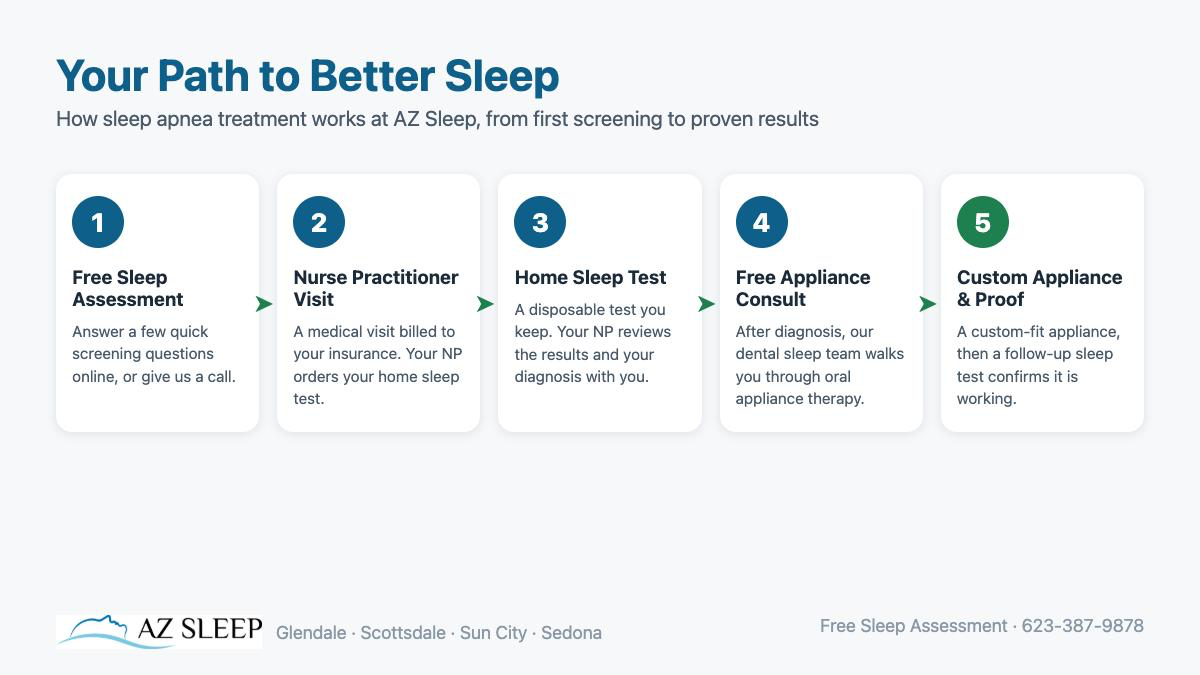
Everything begins with our Free Sleep Assessment. This is a short online screening questionnaire about how you sleep and how you feel during the day. Do you snore? Has a partner ever noticed you gasping or pausing in your breathing at night? Do you wake up with headaches, a dry mouth, or that heavy, foggy feeling that three cups of coffee can’t touch?
Snoring gets all the attention, but daytime symptoms matter just as much. I’ve met plenty of patients (especially women) who never snored loudly but struggled for years with fatigue, irritability, and restless nights before anyone thought to look at their airway.
The assessment doesn’t diagnose anything. It simply tells us whether a sleep test makes sense for you. Think of it as the front door to the whole process. You can take the Free Sleep Assessment on our website, or call us at 623-387-9878 and we’ll walk through it with you.
Step 2: A Visit With Our Nurse Practitioner
If your assessment raises flags, the next step is a visit with our nurse practitioner. This is a medical visit, and it’s billed under your medical insurance. We accept Medicare and medical insurance, because treating sleep apnea is medical care, not cosmetic dentistry.
Our nurse practitioner talks with you about your symptoms and health history. If testing makes sense, the nurse practitioner prescribes your sleep study, so you don’t have to go find a medical provider on your own.
Step 3: The Home Sleep Test, Sleep in Your Own Bed
Once your study is prescribed, you’ll take a home sleep test. Getting tested used to mean a night in a lab, hooked to wires, and a lot of people never followed through. Now we use disposable, FDA-cleared home sleep test devices. You wear the device in your own bed, and while you sleep, it measures things like your breathing, your oxygen levels, and how often your airway narrows or closes. Because the device is disposable, it stays with you for your whole journey with our office. There’s nothing to return. You can read more about how the device works on our home sleep test page.
Step 4: Your Results and Diagnosis With Our Nurse Practitioner
After your test, our nurse practitioner goes over the results with you and makes the diagnosis. That’s where you’ll hear a term worth knowing: AHI. Don’t let the acronym intimidate you. AHI is simply your sleep apnea score. It tells you how many times you stop breathing an hour. A low number means your breathing is mostly steady through the night. A high number means your body is fighting for air over and over, all night long, every night.
That number becomes our shared starting line. If treatment is needed, everything from here is aimed at bringing it down.
Tired of being tired? Start with the Free Sleep Assessment.
Take the Free Sleep Assessment online or call 623-387-9878. Offices in Glendale, Scottsdale, Sun City, and Sedona.
Step 5: Your Complimentary Consultation With Our Dental Sleep Team
Once you have a diagnosis and we’ve received your sleep study and clinical notes from the medical provider, you’ll come see our dental sleep team at the AZ Sleep office closest to you for a complimentary consultation about oral appliance therapy and whether it’s the best course of action for you. It’s the visit people are most anxious about, so let me explain what actually happens. As part of your new patient examination, we look inside your mouth, because an oral appliance is custom dental work and we need to know your teeth, gums, and jaw can support one. And then we answer your questions. All of them.
After decades of these conversations, I can tell you the questions are remarkably consistent. Patients want to know:
- Does it work? For the right patient, yes. And we verify it with a follow-up test rather than asking you to take our word for it. More on that below.
- How does it work? The appliance gently holds your lower jaw slightly forward while you sleep, which keeps your airway open so you can breathe. No machine, no hose, no electricity.
- Is it comfortable? It’s custom-made from molds of your own teeth, so it fits like it belongs there. Most patients adjust within days to a couple of weeks.
- Will insurance pay? How much does it cost? We accept Medicare and medical insurance (this is medical treatment, not cosmetic dentistry), and our team verifies your specific benefits before you commit to anything, so you’ll know your numbers up front.
- How effective is it, and how long until I know it’s working? Many patients notice better mornings within the first weeks. The real answer, though, comes from retesting your AHI once you’ve adjusted to the appliance.
- Are there side effects? Honest answer: some patients notice temporary jaw soreness, extra saliva, or small bite changes early on. We monitor for all of it and adjust the appliance as needed. There are side effects to everything. The question is whether they’re manageable, and for most people these are.
Notice what’s not on that list: pressure to decide on the spot. You can go home, talk it over with your spouse or your doctor, and call us when you’re ready. The patient library on our website is a good place to keep reading in the meantime.
A Word About CPAP, Because You’re Probably Wondering
I want to be clear about something: we don’t bash CPAP. Some people love it; there are side effects to everything, CPAP included, and the best treatment is the one you’ll actually use every night. If you’ve been prescribed CPAP and it’s working for you, wonderful. Keep using it.
But a lot of the patients who find their way to a sleep apnea dentist are people who tried CPAP and couldn’t stick with it, or who were looking for a different option from the start. For many of them, a custom oral appliance is the treatment that finally stays on the nightstand and in the mouth, night after night. That consistency is what actually protects your health.
If you like to read up before a visit, the American Academy of Dental Sleep Medicine has a helpful overview of oral appliance therapy.
Step 6: Your Custom Oral Appliance
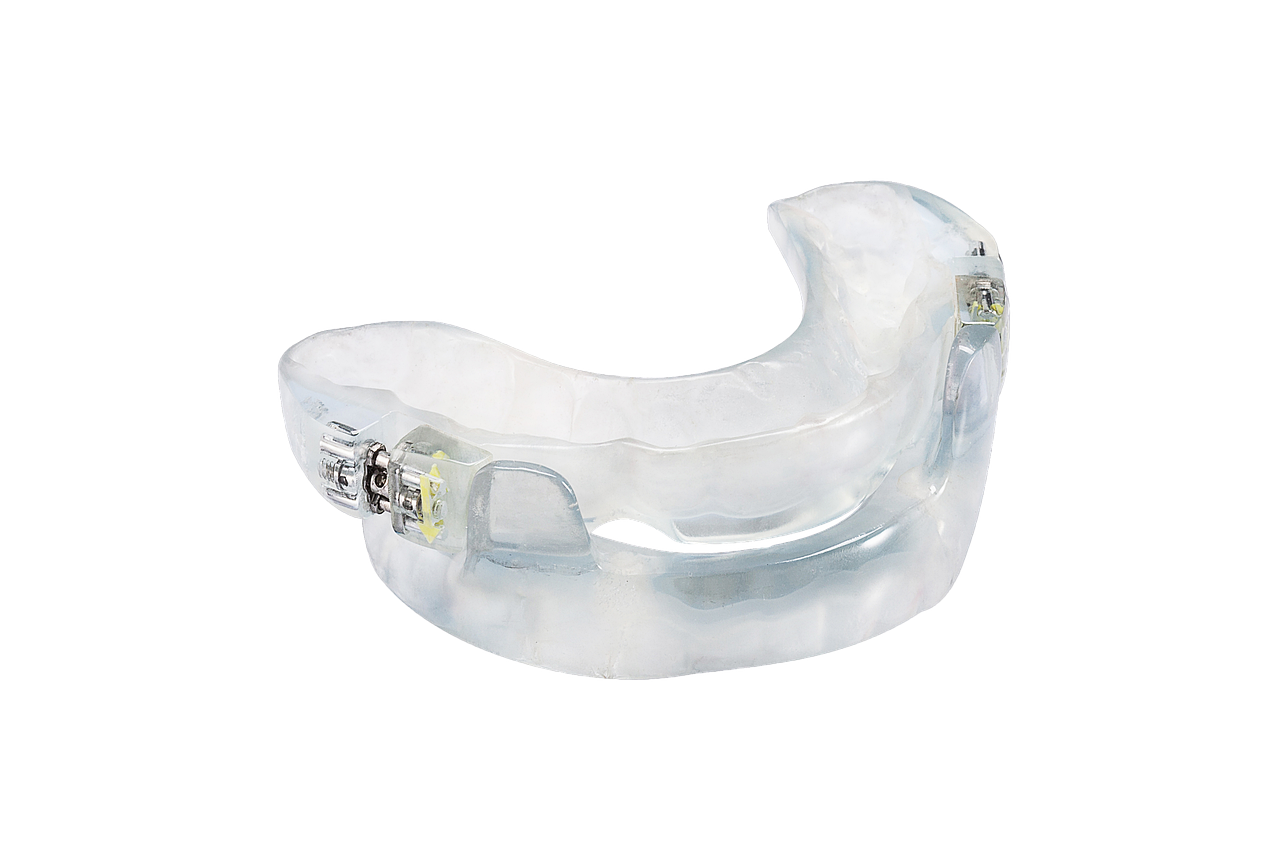
If we decide together that an oral appliance is right for you, the next visit is all about precision. We take detailed impressions or digital scans of your teeth, record how your jaw sits, and send everything to a lab that builds your appliance specifically for your mouth. This is not a boil-and-bite guard from the pharmacy. It’s a medical device made for one person: you.
When it comes back, you’ll come back to our office for a fitting. We check the fit tooth by tooth, teach you how to put it in, take it out, and clean it, and set the starting jaw position. Then you go home and sleep with it.
Over the following weeks we fine-tune. The appliance adjusts in tiny increments, and we nudge it gradually until your symptoms improve: quieter nights, easier mornings, more energy through the afternoon. You’re never just handed a device and waved out the door. Follow-up is part of the treatment, not an add-on.
Ready to find out what’s happening with your sleep?
Start with our Free Sleep Assessment today, or call 623-387-9878. Offices in Glendale, Scottsdale, Sun City, and Sedona.
Step 7: The Follow-Up Efficacy Test, Proving It Works
Here’s the step that separates real sleep apnea treatment from wishful thinking: once you’re comfortable with your appliance and we’ve dialed in the position, we retest. You take a follow-up sleep test with the appliance in, and your new AHI is compared to your original score.
Feeling better matters, but numbers don’t flatter anyone. The efficacy test confirms your airway is actually staying open, which is the whole point. If the numbers aren’t where they should be, we keep adjusting. If they are, you and your medical provider have documented proof that your treatment is doing its job.
A Story That Stays With Me
Let me tell you about one patient, because her story captures why I do this work. She was a woman in the dental field, someone who knew her way around healthcare, and she was struggling with her sleep, her hormone regulation, and relentless daytime fatigue. When she finally tested, her results came back highly severe.
With her custom oral appliance, her AHI went from 57 to 7. Think about that: she went from stopping breathing 57 times an hour to 7. She got her energy back. She started sleeping deeply again. And she meaningfully lowered the strain on her cardiovascular system. Untreated sleep apnea isn’t just about being tired; it’s about what all those nightly oxygen drops do to your heart over the years.
I share her story not as a promise (every patient is different, and no honest clinician guarantees a number) but as a picture of what’s possible when you stop pushing through exhaustion and get tested.
Sleep Apnea Treatment in Arizona: Four Locations, One Phone Number
AZ Sleep has four Arizona locations, so there’s a nearby option whether you’re in the West Valley, the East Valley, the Sun Cities, or up north in Sedona:
- Glendale: 7200 W Bell Road, Suite C3, Glendale, AZ 85308
- Scottsdale: 10245 E Via Linda, Suite 226, Scottsdale, AZ 85258
- Sun City: 13203 N 103rd Ave, Suite G1, Sun City, AZ 85351
- Sedona: 1146 W State Rte 89A, Suite C1, Sedona, AZ 86336
Same team philosophy, same step-by-step process at every office. One phone number reaches all four: 623-387-9878.
What I’d Tell You If You Were Sitting in My Chair
Sleep apnea treatment in Arizona doesn’t have to be complicated or intimidating. Take the Free Sleep Assessment, see our nurse practitioner, take a home sleep test, get your diagnosis, meet our dental sleep team for a complimentary consultation, get a custom appliance if it’s right for you, and confirm it works with a follow-up test. At every step, you’re informed, you’re in control, and you can ask as many questions as you need.
One gentle note before I go: this article is education, not medical advice. Sleep apnea is a medical condition, and your diagnosis and treatment decisions should always involve a medical provider, like our nurse practitioner, reviewing your actual test results. What I can tell you is that ignoring the symptoms doesn’t make them go away. Finding out your sleep apnea score is far less scary than living with the question mark.
You’ve read this far, which tells me your sleep has been on your mind for a while. Take the easy first step. The Free Sleep Assessment takes a few minutes and costs you nothing.
Take your Free Sleep Assessment today.
Call 623-387-9878 or start your Free Sleep Assessment. Offices in Glendale, Scottsdale, Sun City, and Sedona.
Frequently Asked Questions
Does an oral appliance really work for sleep apnea?
For many patients, yes, and we don’t ask you to take it on faith. After you’ve adjusted to your custom appliance, you take a follow-up efficacy test and your new AHI is compared to your original score. If your number hasn’t come down enough, we keep adjusting until it does or we talk honestly about other options.
Is the appliance comfortable to sleep in?
It’s made from precise molds of your own teeth, so it fits your mouth and nobody else’s. Most patients adapt within a few days to a couple of weeks. Early on, you might notice some jaw soreness or extra saliva; we watch for that at your follow-up visits and fine-tune the fit.
Will my insurance cover sleep apnea treatment?
We accept Medicare and medical insurance, because treating sleep apnea is medical care, not cosmetic dentistry. Your visit with our nurse practitioner is billed under your medical insurance. If an oral appliance is recommended, our team verifies your benefits before you commit to anything, so you understand exactly what your plan covers.
How long until I know the treatment is working?
Many patients notice changes (quieter nights, clearer mornings, steadier daytime energy) within the first few weeks. The definitive answer comes from your follow-up efficacy test, which measures how many times you stop breathing per hour with the appliance in place. That’s when “I think I feel better” becomes “here’s the proof.”
Ready to find out what’s happening with your sleep?
It starts with our Free Sleep Assessment: a few quick screening questions, at no cost and with no referral needed. Medicare and medical insurance accepted.
Free Sleep Assessment
or call 623-387-9878 · Glendale · Scottsdale · Sun City · Sedona

Author: Joanna Booher, RDH
25+ years in dentistry · Airway educator with Awaken2Sleep · Licensed Dental Hygienist, AZ #H05418 (verify) · LinkedIn